Construction Companies in Nepal: Services, Types & Selection Guide
Construction Companies in Nepal: Services, Categories and Selection Guide
Construction companies in Nepal provide services ranging from architectural design and cost estimation to complete building construction and final handover. Choosing the right company is one of the most important decisions when building a house, commercial property or other structure.
A reliable construction company can help control costs, maintain quality and coordinate workers, suppliers and technical professionals. It can also ensure that construction follows the approved drawings and agreed specifications.
However, not every construction company in Nepal provides the same level of service or accountability. Some companies supply labour only. Others provide complete design-and-build services, including planning, engineering, material procurement, site supervision, finishing and handover.
Homeowners planning a new residential project can explore Satwa Homes’ house design and construction services to understand how design, engineering and site execution can be managed under one coordinated process.
This guide explains the services offered by construction companies in Nepal. It also covers the main categories of contractors and the factors property owners should review before selecting a company.
What Does a Construction Company Do?
A construction company plans, coordinates and executes building work on behalf of a property owner.
Depending on the contract and service scope, the company may manage:
-
Architectural and structural design
-
Construction drawings
-
Municipal approval coordination
-
Cost estimation and BOQ preparation
-
Site planning and mobilisation
-
Material procurement
-
Labour and subcontractor management
-
RCC structural work
-
Brick masonry and plaster
-
Electrical and plumbing installations
-
Interior and exterior finishing
-
Quality inspections
-
Project reporting
-
Final testing and handover
A professional construction company does more than supply labour. It coordinates architects, engineers, supervisors, contractors, suppliers and skilled workers.
Types of Construction Companies in Nepal
Construction companies in Nepal can be grouped according to the type of project they undertake and the services they provide.
1. Residential construction companies
Residential construction companies specialise in houses, villas, duplex homes, apartments and other residential buildings.
Their services may include:
-
House planning
-
Architectural design
-
Structural design
-
Construction cost estimation
-
Complete house construction
-
Interior finishing
-
Renovation and extension work
-
Project supervision
-
Turnkey construction
A residential specialist is generally more familiar with homeowners’ concerns, including budget management, room planning, material selection, storage, natural lighting, ventilation and future family requirements.
Satwa Homes focuses on residential design, engineering and construction. Our residential construction services help homeowners coordinate planning, cost estimation, structural work, material selection, supervision and final handover.
2. Commercial construction companies
Commercial construction companies work on projects such as:
-
Office buildings
-
Shopping complexes
-
Hotels
-
Restaurants
-
Schools
-
Hospitals
-
Warehouses
-
Institutional buildings
Commercial projects usually require more extensive coordination, service systems, fire-safety planning, accessibility provisions and commercial-grade materials.
A company experienced mainly in houses may not always be the best choice for a large commercial development, and a large infrastructure contractor may not necessarily offer the personal attention required for a family home.
3. Infrastructure construction companies
Infrastructure contractors usually undertake:
-
Roads
-
Bridges
-
Drainage systems
-
Water-supply projects
-
Hydropower-related works
-
Public infrastructure
-
Large civil-engineering projects
These companies often operate with heavy equipment, specialised engineers and larger project teams.
Their experience is valuable for infrastructure projects, but their systems may differ significantly from those of a home construction company in Nepal.
4. Labour contractors
A labour contractor provides workers to complete specific construction activities.
The client generally purchases the construction materials, while the contractor manages the required workforce.
Labour contracts may cover:
-
RCC work
-
Brick masonry
-
Plastering
-
Tile installation
-
Painting
-
Plumbing
-
Electrical work
-
Carpentry
This model can reduce the contractor’s overall responsibility, but it places more responsibility on the homeowner to purchase materials, coordinate suppliers, monitor wastage and verify construction quality.
5. Material-and-labour contractors
Under a material-and-labour contract, the contractor provides both workers and construction materials according to an agreed rate or BOQ.
This arrangement can be easier for homeowners because the contractor manages procurement and labour together.
However, the agreement must clearly define:
-
Material brands
-
Material grades
-
Work specifications
-
Measurement methods
-
Included and excluded items
-
Payment stages
-
Price-adjustment conditions
-
Quality-control requirements
A low quotation may sometimes be based on cheaper materials, missing work items or unclear specifications. Therefore, the total contract value should never be evaluated without reviewing the complete scope.
6. Design-and-build companies
A design-and-build company manages both the design and construction stages.
The same organisation may coordinate:
-
Architectural design
-
Structural design
-
Cost planning
-
Approval documentation
-
Construction
-
Project supervision
-
Finishing
-
Handover
This approach can improve coordination because the design, budget and construction teams work within a single system.
It can also reduce conflicts where one consultant blames the contractor and the contractor blames the drawings.
7. Turnkey construction companies
A turnkey construction company delivers a completed building that is ready for the owner to use, subject to the agreed scope.
The company may manage almost every stage, including:
-
Design
-
Approvals
-
Structural construction
-
Electrical work
-
Plumbing
-
Flooring
-
Doors and windows
-
Painting
-
Sanitary fixtures
-
External development
-
Final cleaning
-
Handover
The meaning of “turnkey” can differ between companies. Some quotations may exclude kitchens, wardrobes, boundary walls, external drainage, utility connections or landscaping.
The agreement must therefore list every inclusion and exclusion clearly.
Main Services Offered by Construction Companies in Nepal
Architectural planning and house design
The architectural design stage determines how the available land will be used.
A well-planned house should consider:
-
Plot size and shape
-
Road access
-
Building orientation
-
Natural lighting
-
Cross ventilation
-
Room relationships
-
Parking
-
Staircase placement
-
Privacy
-
Storage
-
Future expansion
-
Local building requirements
A good design is not simply an attractive front elevation. It must also be practical, structurally possible and appropriate for the homeowner’s budget.
Structural design
Structural engineers design the building’s load-bearing system.
This normally includes:
-
Foundation
-
Columns
-
Beams
-
Slabs
-
Staircases
-
Retaining structures
-
Reinforcement details
-
Structural connections
Structural design should be based on the architectural layout, site conditions, soil considerations and applicable engineering requirements.
Changes made during construction without consulting the structural designer can affect safety and cost.
Cost estimation and BOQ preparation
A Bill of Quantities, commonly called a BOQ, provides a measurable breakdown of construction work.
It may include:
-
Excavation
-
PCC
-
RCC
-
Reinforcement
-
Formwork
-
Brickwork
-
Plaster
-
Flooring
-
Doors and windows
-
Plumbing
-
Electrical installations
-
Painting
-
Sanitary fixtures
-
External works
A detailed BOQ helps the client understand where the budget will be used and provides a basis for comparing contractors.
Comparing only the price per square foot can be misleading because different companies may include different specifications and work items.
Municipal drawing and approval coordination
Construction generally requires approved drawings and relevant local permissions.
A construction or consulting company may help prepare and coordinate:
-
Architectural drawings
-
Structural drawings
-
Application documents
-
Required technical details
-
Corrections requested during review
-
Construction documentation
The exact requirements can vary by municipality, location, road access, plot conditions and building type.
Homeowners should confirm which approval-related services are included in the company’s fee.
Complete building construction
Complete construction may include work from site preparation through final finishing.
Typical stages include:
-
Site survey and preparation
-
Setting out
-
Excavation
-
Foundation construction
-
RCC structural work
-
Brick masonry
-
Electrical and plumbing rough-ins
-
Internal and external plaster
-
Waterproofing
-
Flooring and tile work
-
Door and window installation
-
Painting
-
Sanitary and electrical fixtures
-
Testing and correction
-
Final cleaning and handover
The sequence may vary according to the project design and construction method.
Material procurement
Construction companies may procure materials such as:
-
Cement
-
Reinforcement steel
-
Bricks or blocks
-
Sand
-
Aggregate
-
Formwork materials
-
Electrical cables
-
Plumbing pipes
-
Tiles
-
Sanitary fixtures
-
Paint
-
Doors and windows
Material prices can directly affect the final project budget. Cement rates, for example, vary according to brand, cement type, purchase quantity, transportation and location. Homeowners can review the latest cement price in Nepal before preparing an initial material budget.
Professional procurement requires more than finding the lowest price. Materials should be checked for specification, condition, quantity, manufacturing information where relevant and suitability for the intended work.
Site supervision and quality control
Site supervision ensures that construction follows the drawings and agreed specifications.
Quality-control activities may include:
-
Checking line and level
-
Inspecting reinforcement placement
-
Verifying formwork
-
Monitoring concrete mixing and placement
-
Checking curing
-
Inspecting brick alignment
-
Verifying plumbing slopes
-
Conducting waterproofing checks
-
Reviewing electrical routing
-
Inspecting finishing quality
-
Recording defects and corrective work
A company should be able to explain who will supervise the project and how frequently an engineer will inspect the site.
Project scheduling and reporting
Construction work involves multiple teams and suppliers. Delays in one activity can affect several later stages.
A structured company should maintain:
-
Work schedules
-
Material requirement plans
-
Labour plans
-
Progress records
-
Site photographs
-
Payment records
-
Variation records
-
Pending-decision lists
-
Quality observations
Homeowners should receive regular information about completed work, upcoming activities, required decisions and anticipated expenses.
Contractor, Consultant or Construction Company: What Is the Difference?
These terms are sometimes used interchangeably, but their responsibilities can differ.
Consultant
A consultant generally provides professional services such as:
-
Architectural design
-
Structural design
-
Cost estimation
-
Approval drawings
-
Technical supervision
A consultant may not directly employ or manage all construction workers.
Contractor
A contractor executes construction work according to drawings and specifications.
The contractor may provide labour only or both labour and materials.
Construction company
A construction company may provide a broader combination of design, management, procurement, engineering and construction services.
Some construction companies also operate consulting divisions, while others focus only on execution.
Before signing an agreement, clients should assess the actual service scope rather than relying only on the company’s title.
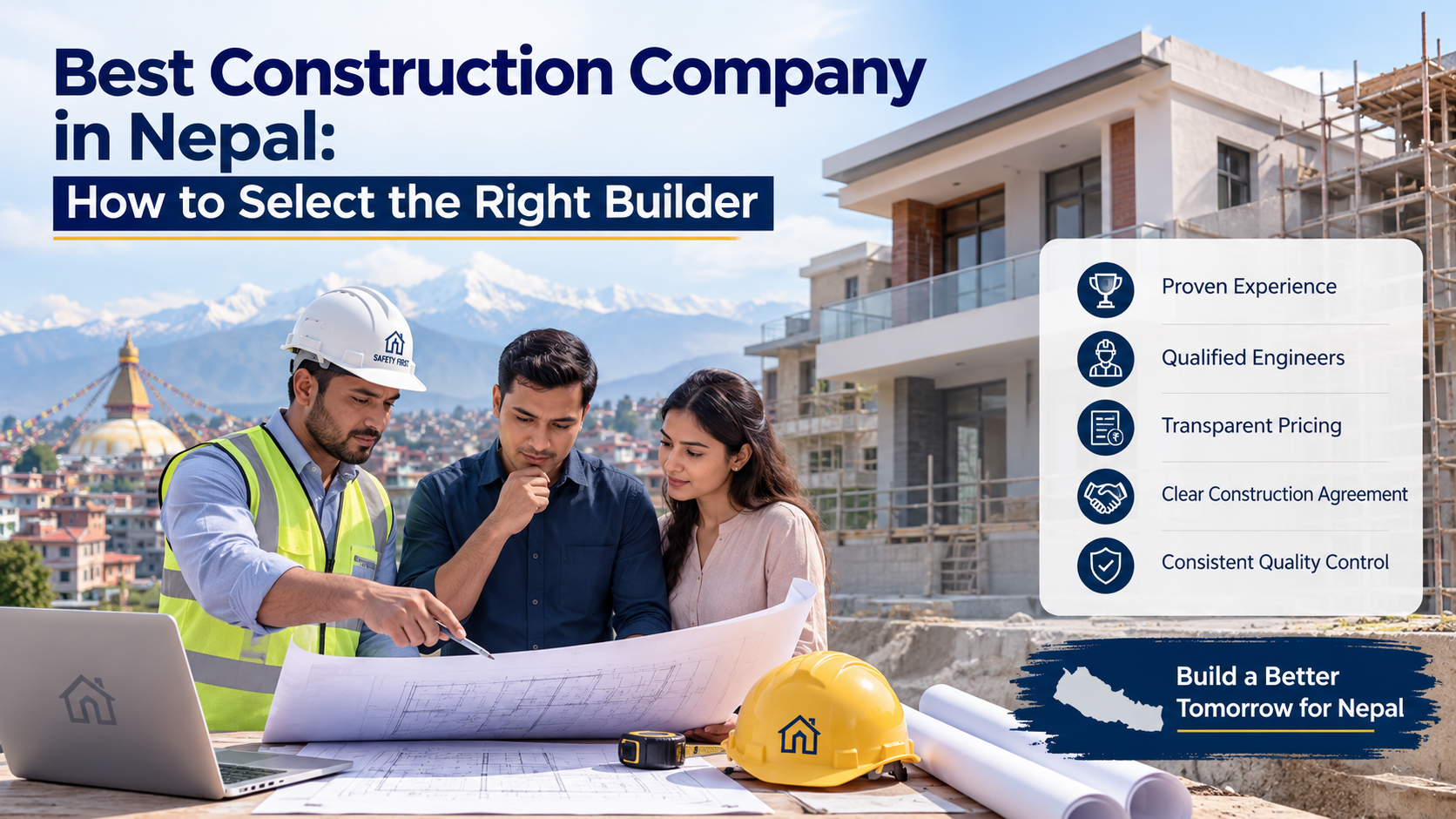
How to Select a Construction Company in Nepal
1. Define your project requirements
Before requesting quotations, establish:
-
Plot location
-
Approximate building size
-
Number of storeys
-
Required rooms
-
Preferred construction quality
-
Expected timeline
-
Available budget
-
Required service scope
A company cannot prepare a reliable proposal without sufficient project information.
2. Check company registration and professional details
Ask the company to provide relevant business and professional information.
Depending on the service, this may include:
-
Company registration details
-
Tax registration information
-
Office address
-
Responsible engineers or architects
-
Professional credentials
-
Contact information
-
Written company profile
Documents alone do not guarantee quality, but they establish accountability and make it easier to verify the organisation.
3. Review completed and ongoing projects
Do not rely only on rendered images or social-media posts.
Request evidence of actual work, including:
-
Completed project photographs
-
Ongoing site photographs
-
Project locations
-
Construction-stage records
-
Client references
-
Site visits where practical
A site visit can reveal how the company manages safety, storage, workmanship, cleanliness and supervision.
4. Evaluate relevant experience
A company that has completed roads or commercial buildings may have strong technical capability, but residential construction has different priorities.
For a house project, check experience in:
-
Residential space planning
-
Homeowner coordination
-
Budget control
-
Small-site logistics
-
Interior finishing
-
Residential plumbing
-
Waterproofing
-
Material selection
-
Client reporting
Choose experience that matches your specific project.
5. Compare scope, not only total price
A low quotation may exclude important work.
When comparing proposals, check whether each one includes:
-
Design fees
-
Structural drawings
-
Approval support
-
Site supervision
-
Excavation
-
Material transportation
-
Formwork
-
Reinforcement
-
Electrical work
-
Plumbing work
-
Waterproofing
-
Doors and windows
-
Painting
-
Sanitary fixtures
-
External works
-
Taxes
-
Testing
-
Waste disposal
All companies should ideally quote against the same drawings, BOQ and specifications.
6. Ask for material specifications
The quotation should identify material expectations wherever possible.
Examples include:
-
Cement type or approved brands
-
Reinforcement grade
-
Brick or block type
-
Concrete grade
-
Electrical wire standard
-
Plumbing pipe type
-
Waterproofing system
-
Tile allowance
-
Paint category
-
Door and window specification
The phrase “standard quality material” is too vague for a major construction contract.
7. Understand the payment schedule
Payments should be linked to measurable construction progress.
A stage-based schedule may relate payments to activities such as:
-
Agreement and mobilisation
-
Foundation completion
-
Ground-floor slab
-
Upper-floor structures
-
Brickwork
-
Plaster
-
Flooring
-
Painting
-
Final fixture installation
-
Handover
Avoid paying a disproportionately large amount before equivalent work has been completed.
The agreement should explain advance payments, retention, variations, delayed payments and final settlement.
8. Review the construction agreement
The contract should clearly mention:
-
Names of both parties
-
Project location
-
Scope of work
-
Drawings and specifications
-
Contract price
-
Measurement method
-
Payment terms
-
Project duration
-
Material responsibilities
-
Client responsibilities
-
Contractor responsibilities
-
Variation procedure
-
Delay provisions
-
Defect-correction responsibility
-
Termination conditions
-
Dispute-resolution process
-
Handover requirements
Verbal assurances should be incorporated into the written agreement.
9. Confirm the supervision system
Ask questions such as:
-
Who will be the site engineer?
-
Will an engineer be present full-time or visit periodically?
-
How often will progress be reported?
-
Who approves reinforcement before concreting?
-
How are changes documented?
-
Who checks material quality?
-
How are defects recorded and corrected?
A professional company should be able to explain its supervision process clearly.
10. Assess communication and transparency
Construction projects require frequent decisions.
A reliable company should communicate:
-
Current progress
-
Upcoming activities
-
Material requirements
-
Budget implications
-
Design conflicts
-
Client decisions needed
-
Delays
-
Variations
-
Quality concerns
Poor communication at the proposal stage can be an early warning of problems during construction.
Warning Signs When Selecting a Construction Company
Be cautious when a company or contractor:
-
Provides an unrealistically low quotation
-
Refuses to give a detailed scope
-
Avoids a written agreement
-
Cannot show actual projects
-
Requests excessive advance payment
-
Uses only verbal material specifications
-
Cannot identify the responsible engineer
-
Pressures the client to decide immediately
-
Changes prices without documentation
-
Promises an unrealistic completion period
-
Has no clear office or accountable contact
-
Uses photographs belonging to other companies
-
Makes unsupported “number one” claims
-
Avoids explaining exclusions
A professional proposal should reduce uncertainty rather than create it.
How Much Do Construction Companies Charge in Nepal?
The cost of hiring a construction company depends on several factors:
-
Project location
-
Total built-up area
-
Number of floors
-
Structural requirements
-
Site access
-
Soil and foundation conditions
-
Material brands
-
Finishing standard
-
Design complexity
-
Labour availability
-
Contractor’s service scope
-
Project duration
-
Transportation requirements
Some companies quote:
-
A rate per square foot
-
A BOQ-based total
-
Labour rates by work item
-
A project-management fee
-
A design-and-supervision fee
-
A fixed turnkey amount
A square-foot rate is useful for an early estimate, but the final agreement should be supported by specifications and a detailed scope.
Two houses with the same area can have significantly different costs because of foundation conditions, floor heights, room layouts, façade design, window sizes, finishing choices and service systems.
Labour Contract vs Turnkey Construction
Labour-contract model
The homeowner purchases materials and the contractor supplies workers.
Possible advantages:
-
Greater control over material selection
-
Direct visibility of material prices
-
Potential savings for experienced owners
Possible disadvantages:
-
Frequent site involvement required
-
Material wastage risk
-
Procurement pressure
-
Supplier coordination
-
Greater responsibility for scheduling
-
Possible disputes over material availability
Turnkey model
The construction company manages both materials and labour according to an agreed scope.
Possible advantages:
-
Single point of responsibility
-
Less daily involvement for the owner
-
Easier coordination
-
More predictable project management
-
Integrated procurement and scheduling
Possible disadvantages:
-
Specifications must be carefully defined
-
Changes can increase costs
-
Weak contracts may create quality disputes
-
The homeowner has less direct procurement control
Neither model is automatically better. The correct choice depends on the owner’s experience, available time, budget-control ability and trust in the selected company.
Why Residential Construction Requires Specialist Management
Building a home is different from constructing a standard commercial shell.
A family home must respond to:
-
Daily routines
-
Family size
-
Privacy
-
Natural light
-
Storage
-
Kitchen workflow
-
Accessibility
-
Parking
-
Future expansion
-
Maintenance
-
Lifestyle preferences
-
Long-term operating costs
Residential construction also involves emotional and financial decisions. Many homeowners are investing years of savings into a single project.
For this reason, a house construction company should combine technical capability with clear communication and careful budget management.
Satwa Homes’ Approach to Residential Construction
Satwa Homes Design and Construction Pvt. Ltd. provides residential design and construction services with an emphasis on coordinated planning, transparent project management and practical construction solutions.
Our process may include:
-
Understanding the client’s requirements
-
Reviewing the plot and project conditions
-
Developing the architectural concept
-
Coordinating structural and technical design
-
Preparing estimates and work specifications
-
Establishing the construction agreement
-
Planning site mobilisation
-
Managing construction activities
-
Conducting technical inspections
-
Reporting progress to the client
-
Correcting identified defects
-
Completing the final handover
Rather than presenting one construction solution for every client, the project scope should be developed according to the land, family requirements, budget and preferred finishing level.
Clients should always request a project-specific consultation and written proposal before making a final decision.
Questions to Ask Before Hiring a Construction Company
Use these questions during meetings with shortlisted companies:
-
How many residential projects have you completed?
-
Can I visit one completed and one ongoing project?
-
Who will supervise my site?
-
What services are included in your quotation?
-
Which items are excluded?
-
Is the quotation based on drawings and a BOQ?
-
Which material brands or specifications are included?
-
How will changes be approved and charged?
-
How will progress be reported?
-
What is the expected construction duration?
-
How are delays handled?
-
What payment schedule do you propose?
-
Who is responsible for material testing?
-
How will defects be corrected?
-
What documentation will I receive during handover?
The quality of the answers can reveal more than the advertised price.
Frequently Asked Questions
Which is the best construction company in Nepal?
There is no single company that is automatically best for every project. The right company depends on the project type, location, budget, technical requirements and required service scope.
A homeowner should compare relevant experience, actual projects, engineering capability, contract clarity, supervision and client references before selecting a company.
How do I verify a construction company in Nepal?
Check its company details, office location, responsible professionals, completed projects, ongoing sites, client references and written proposal.
Whenever possible, visit actual construction sites and speak with previous clients.
Should I choose the lowest construction quotation?
Not necessarily. The lowest quotation may contain missing work, lower specifications, unrealistic quantities or unclear exclusions.
Compare quotations using the same drawings, specifications and BOQ.
What should be included in a construction contract?
The contract should include the scope, drawings, specifications, price, payment schedule, duration, responsibilities, variations, delay terms, quality requirements, defect correction and handover conditions.
Is a turnkey contract better for house construction?
A turnkey contract can be suitable for clients who want one company to manage design, materials, labour and coordination.
However, the specifications and exclusions must be clearly documented before work starts.
Can a construction company also design the house?
Yes. Many design-and-build companies provide architectural, structural and construction services under one organisation.
Clients should still verify the qualifications of the professionals responsible for each part of the design.
How long does it take to construct a house in Nepal?
The duration depends on the building size, number of floors, site conditions, design complexity, weather, labour availability, material supply, client decisions and finishing level.
A project-specific work schedule should be prepared before construction begins.
What is the difference between a contractor and a construction company?
A contractor generally executes construction work, while a construction company may provide broader services such as design, estimation, procurement, engineering, supervision and complete project management.
The actual scope should always be confirmed in writing.
Final Checklist
Before appointing a construction company, confirm that you have:
-
Defined the project requirements
-
Established a realistic budget
-
Reviewed actual completed projects
-
Visited an ongoing site
-
Checked the responsible technical team
-
Compared detailed scopes
-
Reviewed the BOQ
-
Confirmed material specifications
-
Agreed on payment stages
-
Reviewed the project schedule
-
Defined the variation process
-
Signed a detailed contract
-
Retained copies of all drawings and documents
Conclusion
Selecting among the many construction companies in Nepal should not be based only on price, advertising or social-media appearance.
The right company should demonstrate relevant experience, sound engineering, transparent pricing, organised supervision, documented communication and accountability throughout the project.
For residential projects, homeowners should look for a company that understands both the technical requirements of construction and the practical needs of the family who will live in the completed house.
Satwa Homes Design and Construction Pvt. Ltd. works with clients to plan and execute residential projects according to their land, requirements, budget and agreed specifications.
To discuss your house design, construction estimate or complete residential construction requirements, contact the Satwa Homes team for a project-specific consultation.
💡 Satwa Homes Recommendation
For most homeowners building a residential house, we recommend selecting a design-and-build construction company with a detailed BOQ, transparent payment schedule, qualified engineers and regular site supervision. This reduces coordination issues and helps maintain consistent quality throughout construction.