Best Construction Company in Nepal: How to Select the Right Builder
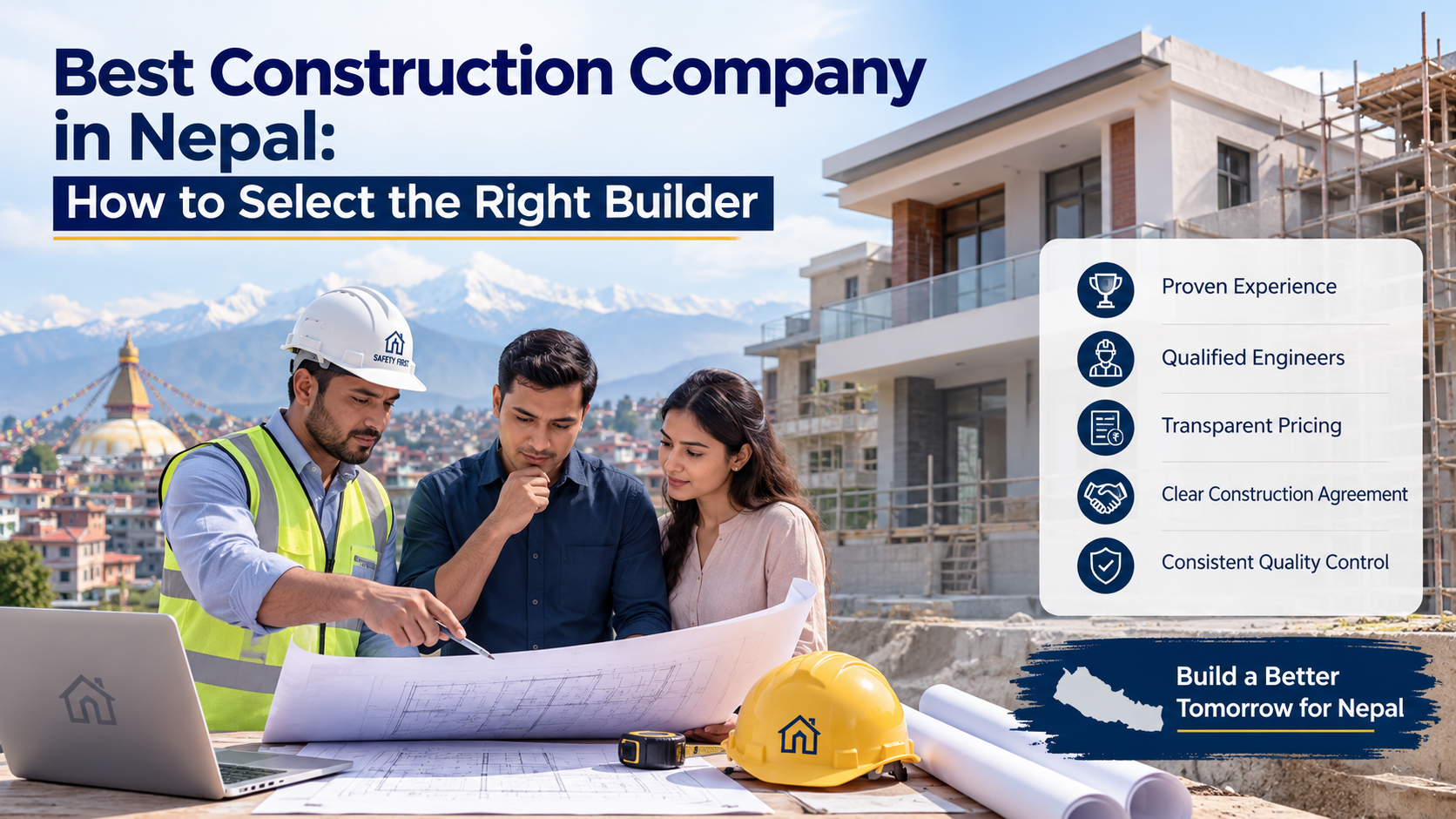
Best Construction Company in Nepal: How to Select the Right Builder
The best construction company in Nepal should be selected based on proven experience, qualified engineers, transparent pricing, clear construction agreements and consistent quality control. Building a house is one of the largest financial decisions most families make. Selecting the right construction company is therefore just as important as selecting the land, house design or construction materials.
The best construction company in Nepal should not be selected only on the basis of the lowest quotation, an attractive social media page or verbal promises. A reliable builder should have qualified technical personnel, a transparent cost breakdown, clearly defined specifications, documented projects, a proper construction agreement and a dependable system for monitoring quality.
Before appointing a builder, homeowners should compare the company’s experience, legal status, engineering team, completed work, payment conditions, quality-control process and post-construction support.
This guide explains how to assess construction companies in Nepal and select the right builder for your house.
What Does a Construction Company Do?
A residential construction company coordinates the professionals, workers, materials, schedules and technical processes required to convert a house design into a completed building.
Depending on the service agreement, a home construction company in Nepal may handle:
-
Architectural planning
-
Structural design
-
Municipal drawing preparation
-
Cost estimation
-
Bill of quantities preparation
-
Material procurement
-
Labour management
-
RCC construction
-
Brickwork and plastering
-
Plumbing and electrical work
-
Waterproofing
-
Flooring and finishing
-
Painting
-
Site supervision
-
Quality inspections
-
Project handover
Some companies offer only structural construction, while others provide complete design-and-build services. Homeowners should confirm exactly what is included before comparing prices.
How to Select the Best Construction Company in Nepal
There is no single company that will be the right choice for every type of project. The best builder for your house will be the company that can meet your specific requirements, budget, location, quality expectations and construction schedule.
The following factors should be examined carefully.
1. Verify the Company’s Registration and Professional Identity
Start by confirming that the builder operates through a properly registered business.
Ask the company to provide its:
-
Registered company name
-
Office address
-
Company registration information
-
PAN or VAT details
-
Official contact information
-
Engineering or architectural team details
-
Written quotation
-
Construction agreement
Payments should be made through documented channels and supported by invoices, receipts or payment certificates.
Working with a documented company provides greater accountability than relying entirely on an individual contractor without formal records.
A professional construction company should be willing to issue documents under its registered business name and clearly identify the people responsible for the project.
2. Review Completed and Ongoing Projects
A builder’s previous work is one of the strongest indicators of its actual capability.
Do not judge a construction company only from rendered images or social media graphics. Ask to see evidence from real projects, including:
-
Foundation work
-
Reinforcement placement
-
Column and beam construction
-
Slab casting
-
Brick masonry
-
Electrical and plumbing installations
-
Waterproofing work
-
Plastering
-
Flooring
-
Interior finishing
-
Completed buildings
Whenever practical, visit at least one ongoing site and one completed project.
An ongoing project helps you understand how the company manages workers, materials, safety, storage and daily supervision. A completed house allows you to evaluate finishing quality and speak with the homeowner about their experience.
Questions to ask previous clients
Ask former clients:
-
Was the project completed close to the agreed schedule?
-
Were costs explained clearly?
-
How were additional works handled?
-
Did engineers visit the site regularly?
-
Was the company responsive when problems occurred?
-
Did the completed work match the agreed specifications?
-
Did the company provide support after handover?
One honest conversation with a previous client can reveal more than dozens of promotional posts.
3. Check Who Will Supervise Your House
Residential construction requires more than labour and materials. It requires regular technical decisions.
Ask the company who will be responsible for:
-
Structural verification
-
Reinforcement inspection
-
Concrete work
-
Level and alignment checks
-
Material approval
-
Electrical coordination
-
Plumbing coordination
-
Waterproofing inspection
-
Work measurement
-
Progress reporting
A qualified engineer should be involved at important construction stages. However, homeowners should also ask how frequently the assigned engineer will visit and how observations will be recorded.
A company may have engineers in its office, but that does not automatically mean your project will receive consistent site supervision.
Request the name and role of the person assigned to your project before signing the agreement.
4. Ask for a Detailed Cost Estimate
A one-page quotation with only a total cost or rate per square foot is not enough for a major house construction project.
A professional estimate should explain:
-
Total built-up area
-
Scope of construction
-
Structural specifications
-
Cement specifications
-
Reinforcement steel specifications
-
Brick or block type
-
Sand and aggregate requirements
-
Concrete grades
-
Door and window allowances
-
Electrical provisions
-
Plumbing and sanitary provisions
-
Waterproofing scope
-
Flooring allowances
-
Painting system
-
External development work
-
Labour responsibilities
-
Taxes
-
Transportation
-
Exclusions
-
Payment schedule
Two companies may quote different rates because they are offering completely different specifications. A lower rate does not necessarily indicate better value.
For example, one quotation may include waterproofing, electrical wiring, sanitary fixtures and external drainage, while another may exclude them. Comparing only the final rate would therefore be misleading.
5. Request a Bill of Quantities
A Bill of Quantities, commonly called a BOQ, divides the construction into measurable work items.
A BOQ may include:
-
Excavation
-
Plain cement concrete
-
Reinforced cement concrete
-
Reinforcement steel
-
Formwork
-
Brick masonry
-
Internal plaster
-
External plaster
-
Flooring
-
Waterproofing
-
Electrical work
-
Plumbing work
-
Painting
-
Doors and windows
The BOQ helps homeowners understand how the estimated cost was calculated. It also provides a basis for monitoring quantities, variations and payments.
A BOQ is particularly important when payments are based on completed work rather than a fixed turnkey amount.
6. Compare Specifications, Not Only Price
The phrase “construction rate per square foot” can be misleading unless the specification is clearly defined.
Before accepting a rate, ask:
-
Which cement brands or standards are permitted?
-
Which reinforcement steel is specified?
-
What brick or block type will be used?
-
What concrete grades are included?
-
What is the flooring allowance?
-
What are the sanitary and electrical allowances?
-
What waterproofing system is proposed?
-
Are doors and windows included?
-
Is exterior development included?
-
Are design and approval costs included?
-
Does the rate include VAT?
-
Does it include soil-related foundation changes?
A builder offering a cheaper package may use lower allowances, exclude important work or charge separately for items that appear later.
The most suitable quotation is the one that provides the required quality at a transparent and manageable cost.
7. Examine the Construction Agreement
Never begin major construction based entirely on verbal discussions.
A written agreement should clearly define:
-
Names and details of both parties
-
Project location
-
Approved drawings
-
Scope of work
-
Technical specifications
-
Contract value or rate
-
Payment schedule
-
Project commencement date
-
Expected completion period
-
Client responsibilities
-
Contractor responsibilities
-
Material procurement responsibilities
-
Variation procedure
-
Delay conditions
-
Quality requirements
-
Defect correction
-
Termination conditions
-
Dispute-resolution procedure
-
Handover requirements
Any important promise made during negotiation should be included in the agreement.
Statements such as “we will manage it later” or “this is normally included” can create disputes when they are not documented.
Both parties should understand the agreement before signing it.
8. Understand the Payment Schedule
A dependable construction company should connect payments to defined construction progress.
Possible payment stages may include:
-
Mobilisation and site setup
-
Foundation completion
-
Ground-floor structural completion
-
Upper-floor structural completion
-
Brickwork completion
-
Plaster and service installation
-
Finishing stages
-
Final inspection and handover
The exact structure will depend on the project and contract type.
Avoid paying an unreasonably large proportion of the total cost before corresponding work has been completed. At the same time, payments should be released on time when the builder achieves an agreed stage.
A balanced payment schedule protects both the homeowner and the construction company.
9. Evaluate the Quality-Control Process
Quality should be monitored throughout construction rather than checked only after completion.
Ask the builder how it verifies:
-
Excavation depth
-
Foundation dimensions
-
Reinforcement diameter and spacing
-
Column alignment
-
Formwork stability
-
Concrete proportions or grade
-
Concrete compaction
-
Curing
-
Brick alignment
-
Plaster thickness
-
Plumbing pressure
-
Electrical conduits
-
Bathroom waterproofing
-
Roof waterproofing
-
Floor levels
-
Door and window dimensions
Important work often becomes hidden after concrete casting, plastering or flooring. Inspection should therefore happen before the next layer covers it.
A professional company should be able to explain its inspection stages and maintain site records, photographs, checklists or progress reports.
10. Confirm How Material Quality Is Controlled
Even a good design can perform poorly when unsuitable materials are used or stored incorrectly.
The construction company should have a process for checking:
-
Cement type and manufacturing date
-
Condition of cement bags
-
Reinforcement steel diameter
-
Steel weight or certification
-
Brick strength and uniformity
-
Sand cleanliness
-
Aggregate grading
-
Water quality
-
Waterproofing products
-
Electrical cables
-
Plumbing pipes
-
Paint systems
-
Tile quality
Materials should also be stored correctly. Cement must be protected from moisture, reinforcement should not be left in harmful conditions, and plumbing or electrical products should remain identifiable before installation.
Ask whether the homeowner can review major material purchases and whether substitutions require approval.
11. Check Communication and Reporting
Construction involves hundreds of decisions. Poor communication can produce delays, mistakes and unexpected expenses even when the technical work is acceptable.
Before appointing a builder, ask how communication will be managed.
A suitable reporting system may include:
-
Weekly progress updates
-
Site photographs
-
Work completed
-
Work planned
-
Material requirements
-
Decisions pending from the client
-
Payment status
-
Approved variations
-
Delay notices
There should be one clearly identified contact person for technical and administrative communication.
Instructions that affect cost, design or quality should be confirmed in writing rather than communicated only through phone calls.
12. Ask How Additional Work Is Handled
Changes commonly arise during house construction. A homeowner may change a room layout, upgrade tiles, add electrical points or select different fixtures.
The construction agreement should explain how variations will be:
-
Requested
-
Measured
-
Priced
-
Approved
-
Added to the schedule
-
Recorded in the final account
The builder should not carry out major additional work and present an unexplained bill later. Similarly, the client should not expect substantial extra work to be completed without an adjustment to cost or time.
A written variation system prevents many construction disputes.
13. Evaluate the Proposed Timeline
Be cautious when a builder promises an unrealistically fast completion date without examining the drawings, site conditions and scope.
The construction schedule may be affected by:
-
Building size
-
Number of storeys
-
Ground conditions
-
Site access
-
Monsoon weather
-
Material availability
-
Labour availability
-
Design revisions
-
Client selections
-
Municipal processes
-
Neighbouring structures
-
Utility coordination
-
Payment delays
Ask for a phase-wise schedule rather than only a final completion date.
The schedule should identify important stages such as foundation work, structural construction, masonry, services, plaster, flooring, painting and handover.
14. Ask About Post-Construction Support
A builder’s responsibility should not necessarily end the day the keys are handed over.
Ask how the company handles concerns discovered after occupancy, such as:
-
Minor plumbing leakage
-
Electrical defects
-
Door or window adjustment
-
Waterproofing concerns
-
Paint touch-ups
-
Drainage issues
-
Incomplete items
The agreement should define the defect-correction process and any applicable support period.
A company that maintains proper records and remains accessible after project completion provides greater confidence than one that disappears after receiving the final payment.
Warning Signs When Selecting a Builder
Homeowners should proceed carefully when a contractor or construction company:
-
Refuses to provide registration information
-
Avoids written agreements
-
Provides no project references
-
Gives only a verbal total price
-
Offers an unusually low rate without specifications
-
Requests excessive advance payment
-
Cannot identify the project engineer
-
Avoids explaining material brands or allowances
-
Pressures the client to sign immediately
-
Makes unrealistic completion promises
-
Cannot explain how additional work will be priced
-
Uses only rendered images instead of actual project evidence
-
Is unwilling to let the client visit an ongoing site
One warning sign does not automatically prove that a company is unreliable, but several together indicate significant risk.
Questions to Ask a Construction Company
Use this checklist during meetings with shortlisted builders.
Company and experience
-
How long has the company been operating?
-
What type of buildings does it normally construct?
-
Can I visit ongoing and completed projects?
-
Can I speak with previous clients?
-
Who owns and manages the company?
Technical team
-
Who will design the house?
-
Who will prepare or verify the structural design?
-
Who will supervise the site?
-
How often will an engineer visit?
-
How will quality inspections be documented?
Cost
-
Is the quotation fixed-price, item-rate or cost-plus?
-
Is a detailed BOQ available?
-
What is included and excluded?
-
Does the price include VAT?
-
Which material and fixture allowances are included?
-
How will price changes be handled?
Construction process
-
What is the expected timeline?
-
Who purchases the materials?
-
How will material quality be checked?
-
How will progress be reported?
-
How will changes be approved?
-
What happens if work is delayed?
Handover and support
-
What documents will be supplied at handover?
-
How will incomplete work be recorded?
-
What post-construction support is provided?
-
How are defects reported and corrected?
Contractor, Consultant or Design-and-Build Company?
Homeowners in Nepal may choose from several project-delivery approaches.
Labour contractor
A labour contractor generally supplies workers while the homeowner purchases materials and manages technical coordination.
This model may provide greater purchasing control, but it requires considerable involvement from the homeowner or an appointed consultant.
General contractor
A general contractor may manage labour, materials and construction based on drawings provided by the client or consultant.
The exact responsibility depends on the contract.
Consultant-managed construction
The homeowner appoints architects or engineers for design and supervision, then hires separate contractors for execution.
This can provide independent oversight but requires careful coordination between parties.
Design-and-build company
A design-and-build company manages design and construction through one coordinated organisation.
This model can simplify communication and responsibility, provided that the scope, specifications, professional roles and cost structure are transparent.
No model is automatically best. The correct choice depends on the homeowner’s experience, available time, budget and desired level of control.
Why the Cheapest Construction Company May Cost More
A very low initial quotation may become expensive when it excludes necessary items or creates repeated variation claims.
Possible hidden or underestimated expenses include:
-
Soil-related foundation changes
-
Debris disposal
-
Water and electricity for construction
-
Scaffolding
-
Waterproofing
-
External drainage
-
Septic or sewer connections
-
Boundary work
-
Utility connections
-
Design revisions
-
Additional reinforcement
-
Transportation
-
Material price changes
-
Taxes
-
Upgraded finishes
Before comparing quotations, place them side by side and normalise the scope. Confirm that every company is pricing the same drawings, specifications and inclusions.
How Satwa Homes Approaches Residential Construction
Satwa Homes Design and Construction Pvt. Ltd. provides residential design and construction services in Nepal with an emphasis on documented planning, transparent scope and coordinated project execution.
Our approach begins by understanding:
-
Plot conditions
-
Family requirements
-
Desired room layout
-
Built-up area
-
Budget
-
Structural requirements
-
Finish expectations
-
Construction timeline
The project can then be developed through design, estimation, specification preparation, construction planning and site execution.
For homeowners comparing construction companies in Nepal, we encourage careful review of drawings, specifications, cost assumptions and contract conditions before construction begins.
A successful house is not produced by marketing claims. It is produced through planning, engineering, material control, skilled workmanship, regular supervision and clear communication between the homeowner and construction team.
Documents to Request Before Starting Construction
Before work begins, organise the following documents as applicable to your project:
-
Final architectural drawings
-
Structural drawings
-
Service drawings
-
Approved municipal drawings
-
Detailed quotation
-
Bill of Quantities
-
Material specifications
-
Construction agreement
-
Payment schedule
-
Work schedule
-
Variation format
-
Contact details of responsible personnel
-
Site progress-reporting arrangement
Store digital and printed copies safely. These documents provide a common reference throughout construction.
Final Checklist for Selecting the Right Builder
Before making the final decision, confirm that the company:
-
Operates through a registered business
-
Has a verifiable office and contact details
-
Can show real completed and ongoing projects
-
Has identified technical personnel
-
Provides a detailed quotation
-
Clearly defines materials and specifications
-
Supplies or works from an appropriate BOQ
-
Uses a written construction agreement
-
Links payments to measurable progress
-
Has a quality-inspection process
-
Communicates regularly
-
Documents additional work
-
Provides realistic timelines
-
Explains post-construction support
Choose the company that provides the strongest combination of transparency, technical capability, communication, workmanship and value—not simply the lowest initial price.
Conclusion
Selecting the best construction company in Nepal requires more than searching for a popular company name or comparing rates per square foot.
A dependable builder should demonstrate real project experience, provide clear technical and financial documents, assign responsible professionals, follow approved drawings, maintain material quality and communicate openly throughout construction.
Take time to compare multiple companies, visit their projects, review their agreements and understand every major inclusion before making a commitment.
The right construction partner can help protect your budget, maintain quality and turn your plans into a safe, practical and well-executed home.
Discuss Your House Construction with Satwa Homes
Planning to design or build a house in Nepal?
Satwa Homes can help you assess your plot, space requirements, construction scope, estimated budget and suitable project-delivery approach.
Contact the Satwa Homes team to discuss your residential design or construction requirements.
Frequently Asked Questions
Which is the best construction company in Nepal?
The best construction company depends on the project’s location, size, budget, specification and service requirements. Compare registered companies based on their completed projects, engineering team, quotation, BOQ, agreement, supervision process, communication and client references.
How do I verify a construction company in Nepal?
Request its registered company name, office details, PAN or VAT information, official quotation, project portfolio and technical team information. You should also visit actual project sites and speak with previous clients.
How many construction companies should I compare?
It is generally useful to evaluate at least three suitable companies. However, all companies must price the same drawings, specifications and scope for the comparison to be meaningful.
Should I choose the lowest construction quotation?
Not automatically. A lower quotation may exclude important work, use smaller allowances or provide different specifications. Compare scope, materials, professional supervision, payment conditions and exclusions before comparing the total amount.
What should a house construction agreement include?
It should define the scope, drawings, specifications, contract value, payment stages, timeline, responsibilities, variation procedure, quality requirements, delay conditions, defect correction and handover process.
Is a BOQ necessary for house construction?
A BOQ is strongly recommended because it explains the measured work and estimated quantities. It helps homeowners compare quotations, monitor progress, assess variations and verify payments.
Should an engineer supervise house construction?
Important construction stages should be inspected by appropriately qualified technical professionals. Ask the company who will supervise the project, how often inspections will occur and how observations will be documented.
What is included in turnkey house construction?
The meaning of turnkey construction differs between companies. It may include design, structure, electrical, plumbing, finishes and handover, but homeowners must review the exact inclusions, allowances and exclusions in writing.
How can I avoid hidden construction costs?
Use complete drawings, detailed specifications, a BOQ and a written agreement. Ask about taxes, transportation, external development, utility connections, soil conditions, design changes, price escalation and excluded work before signing.
Does Satwa Homes provide house design and construction services?
Satwa Homes Design and Construction Pvt. Ltd. provides residential design and construction services. The exact services and scope can be discussed and documented according to the project’s location, requirements, specifications and budget.