Brick Price in Nepal 2026: Machine-Made & Traditional Rates
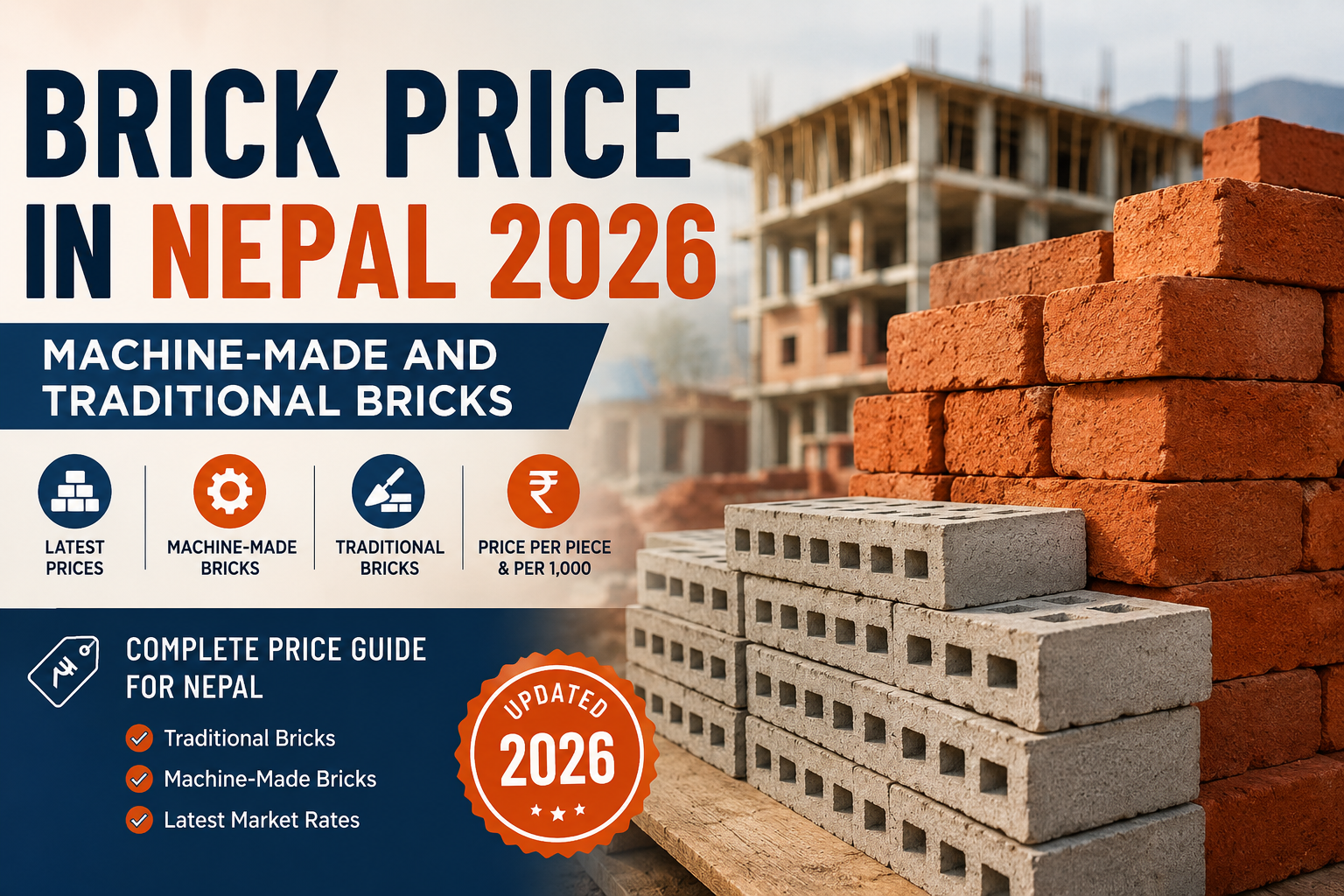
Brick Price in Nepal 2026: Machine-Made and Traditional Brick Rates
Last updated: July 2026
Bricks remain one of the most commonly used wall-construction materials in Nepal. Whether you are constructing a house in Kathmandu, Lalitpur, Bhaktapur, Pokhara, Chitwan or another part of Nepal, understanding the current brick price in Nepal is important for preparing an accurate construction budget.
In 2026, the price of a standard brick in Nepal generally ranges from approximately NPR 14 to NPR 28 per piece, depending on the brick type, quality, manufacturing method, supplier and delivery location. Traditional red-clay bricks are normally more affordable, while machine-made bricks cost more because of their uniform size, smooth finish and controlled production.
Brick Price in Nepal 2026
The following table provides an indicative comparison of commonly available brick rates in Nepal.
| Brick type | Approximate price per piece | Approximate price per 1,000 bricks | Common use |
|---|---|---|---|
| Traditional red-clay brick | NPR 14–22 | NPR 14,000–22,000 | Internal and external walls |
| First-class traditional brick | NPR 18–25 | NPR 18,000–25,000 | Residential masonry walls |
| Machine-made brick | NPR 20–28 | NPR 20,000–28,000 | Uniform masonry and exposed walls |
| Chinese or machine-finished brick | NPR 22–28 | NPR 22,000–28,000 | Premium and accurate wall construction |
| Wire-cut brick | NPR 18–25 | NPR 18,000–25,000 | Exposed brickwork and decorative walls |
| Fly-ash brick | NPR 15–25 | NPR 15,000–25,000 | Lightweight partition walls |
| Fire brick | NPR 55–120 | Varies by specification | Chimneys, furnaces and high-temperature areas |
Publicly available Nepal construction-market guides currently place ordinary red-clay bricks around NPR 14–25 per piece and machine-made or Chinese bricks around NPR 22–28 per piece. These prices should be treated as market guidance rather than fixed supplier quotations.
Important: Always ask whether the quoted price includes transportation, loading, unloading, VAT and replacement of broken bricks. A cheaper kiln price can become more expensive after delivery charges are added.
Traditional Brick Price in Nepal
Traditional red-clay bricks are manufactured by moulding clay and firing it inside a brick kiln. They are widely available across Nepal and remain a popular choice for residential construction.
In 2026, the approximate price of a traditional brick in Nepal is:
-
Ordinary traditional brick: NPR 14–18 per piece
-
Better-quality red brick: NPR 18–22 per piece
-
Selected first-class brick: NPR 20–25 per piece
The final price depends heavily on firing quality, strength, size consistency, breakage percentage and transportation distance.
Traditional bricks are normally suitable for plastered walls when the supplied batch has adequate strength and consistent firing. However, irregular bricks can increase mortar consumption and labour requirements because masons need more time to maintain proper wall alignment.
Machine-Made Brick Price in Nepal
Machine-made bricks are produced using mechanical moulding, pressing, extrusion or wire-cutting equipment. In Nepal, they are also frequently referred to in the market as Chinese bricks, although the term usually describes the manufacturing style rather than the country of origin.
The approximate machine-made brick price in Nepal in 2026 is:
-
Standard machine-made brick: NPR 20–25 per piece
-
Premium machine-made brick: NPR 24–28 per piece
-
Machine-made exposed brick: NPR 25–30 or more per piece, depending on finish
Machine-made bricks are generally more expensive than ordinary traditional bricks, but they offer:
-
more uniform dimensions;
-
straighter edges;
-
better wall alignment;
-
controlled surface finish;
-
potentially lower mortar consumption;
-
faster and cleaner masonry work;
-
better appearance for exposed brick walls.
Machine-made bricks can be particularly useful where accurate wall dimensions, straight corners and a high-quality finish are required.
Machine-Made Brick vs Traditional Brick
| Comparison | Machine-made brick | Traditional brick |
|---|---|---|
| Price | Generally higher | Generally lower |
| Size consistency | Very consistent | Can vary between batches |
| Edge quality | Sharp and uniform | May be uneven |
| Surface finish | Smooth and controlled | Rougher and more natural |
| Mortar requirement | Usually lower when dimensions are uniform | May be higher if sizes vary |
| Construction speed | Faster alignment | More adjustment may be required |
| Exposed brickwork | More suitable | Depends on appearance and quality |
| Availability | Depends on factory and supplier | Widely available |
| Typical application | Premium walls and accurate masonry | General residential wall construction |
The more expensive brick is not automatically the best choice for every project. Brick selection should be based on structural drawings, wall type, finishing requirements, budget and the engineer’s recommendation.
Brick Price in Kathmandu, Lalitpur and Bhaktapur
Brick prices inside Kathmandu Valley may be higher than kiln or factory prices because of:
-
transportation costs;
-
restrictions on heavy-vehicle movement;
-
loading and unloading;
-
supplier margins;
-
fuel prices;
-
construction-season demand;
-
distance between the kiln and project site;
-
road width and site accessibility.
Indicative delivered prices in Kathmandu Valley commonly fall between:
| Brick type | Indicative delivered rate |
|---|---|
| Traditional red brick | NPR 18–25 per piece |
| Machine-made brick | NPR 22–28 per piece |
| Premium or exposed brick | NPR 25–30+ per piece |
Published 2026 market guides similarly report that Kathmandu Valley prices can be higher than production-area prices, with transport and retail margins increasing the final delivered cost.
Before placing an order, request at least two or three written quotations for the same brick specification and delivery location.
Standard Brick Size in Nepal
A commonly quoted brick dimension in the Nepalese construction market is approximately:
-
Brick size without mortar: 230 mm × 110 mm × 55 mm
-
Nominal size with mortar allowance: approximately 240 mm × 115 mm × 57 mm
Actual brick sizes can differ between traditional kilns and machine-made factories. Therefore, brick dimensions should be checked before preparing the final quantity estimate.
Uniform brick size is important because it affects:
-
wall thickness;
-
mortar consumption;
-
number of bricks required;
-
door and window openings;
-
plaster thickness;
-
construction speed;
-
alignment of masonry walls.
Market construction guides commonly use dimensions close to 230 mm × 110 mm × 55 mm when explaining standard brick sizes in Nepal.
How Many Bricks Are Required Per Square Metre?
For a conventional brick measuring around 230 mm × 110 mm × 55–75 mm, the approximate requirement may be:
| Wall thickness | Approximate bricks per square metre |
|---|---|
| Half-brick wall, approximately 4.5 inches | 55–60 bricks |
| Full-brick wall, approximately 9 inches | 110–120 bricks |
These figures are approximate and can change depending on:
-
actual brick dimensions;
-
mortar-joint thickness;
-
wall bond;
-
openings;
-
wall thickness;
-
construction details;
-
brick breakage and cutting.
A 2026 Nepal construction guide similarly estimates approximately 55–60 bricks per square metre for a half-brick wall and 110–120 bricks for a full-brick wall.
Example Brick Cost Calculation
Suppose a project has 100 square metres of half-brick wall.
Step 1: Calculate the approximate number of bricks
100 square metres × 58 bricks
= 5,800 bricks
Step 2: Add allowance for breakage and cutting
5,800 + 5% allowance
= approximately 6,090 bricks
Step 3: Calculate the brick cost
At NPR 20 per traditional brick:
6,090 × NPR 20
= NPR 121,800
At NPR 25 per machine-made brick:
6,090 × NPR 25
= NPR 152,250
This calculation includes only the brick purchase price. It does not include:
-
cement;
-
sand;
-
masonry labour;
-
transportation;
-
loading and unloading;
-
scaffolding;
-
plaster;
-
curing;
-
VAT;
-
site wastage beyond the allowed percentage.
For a reliable project estimate, brick quantity should be calculated from the approved architectural and structural drawings rather than from total floor area alone.
Factors Affecting Brick Price in Nepal
1. Brick quality
Properly fired, uniform and stronger bricks normally cost more than under-burnt or irregular bricks.
2. Manufacturing method
Machine-made and wire-cut bricks are generally more expensive because their production offers better dimensional control.
3. Transportation distance
Delivery can add a substantial amount to the final cost, especially for projects far from a brick kiln or factory.
4. Fuel and production costs
Brick kilns use fuel during the firing process. Changes in coal, diesel, electricity and labour expenses can affect brick rates.
5. Seasonal availability
Production and transportation can be affected during the monsoon. Prices may also change during peak construction seasons.
6. Order quantity
Large orders may receive better factory or supplier rates than small quantities.
7. Loading and unloading
Some quotations include loading but exclude unloading at the project site.
8. Site access
A project located on a narrow road or difficult terrain may require smaller delivery vehicles or additional manual handling.
9. Breakage policy
A supplier offering replacement for excessive breakage may charge slightly more but provide better overall value.
How to Check Brick Quality Before Buying
Price should never be the only basis for selecting bricks. Before approving a full order, inspect a sample from the actual batch.
Check the shape
Good bricks should have reasonably straight edges, uniform dimensions and flat surfaces.
Check the colour
A uniform, well-fired colour generally indicates more consistent burning. Extremely pale bricks may be under-burnt, while heavily distorted or dark bricks may be over-burnt.
Check for cracks
Avoid bricks with visible cracks, damaged corners or excessive surface defects.
Perform a sound test
Strike two bricks lightly together. A good brick should generally produce a clear ringing sound rather than a dull sound.
Check hardness
The surface should not easily crumble or develop deep marks under light scratching.
Check water absorption
Bricks with excessive water absorption can draw water rapidly from the mortar and may affect masonry performance. Technical testing is preferable for large or important projects.
Check efflorescence
Excessive white salt deposits may indicate soluble salts in the brick.
Check breakage
Inspect bricks from different areas of the delivery vehicle rather than checking only the bricks placed on top.
Satwa Homes Site Recommendation
For residential construction, Satwa Homes recommends selecting bricks based on their actual quality, dimensions and intended use, not only on the lowest per-piece rate.
For plastered partition walls, properly fired and approved traditional bricks may provide good value. For exposed brickwork, walls requiring accurate alignment, or projects where dimensional consistency is important, machine-made bricks may be more suitable.
Before ordering bricks:
-
confirm the required quantity from the BOQ and drawings;
-
collect quotations from multiple suppliers;
-
compare the delivered price rather than only the factory price;
-
inspect samples from the proposed batch;
-
confirm transportation and unloading costs;
-
agree on the acceptable breakage percentage;
-
obtain approval from the project engineer;
-
place the order according to the construction schedule.
Buying the cheapest bricks without checking quality may increase mortar usage, plaster thickness, labour time and wastage. A slightly higher-quality brick can sometimes reduce the total completed wall cost.
Traditional Brick or Machine-Made Brick: Which Should You Choose?
Choose traditional bricks when:
-
the walls will be plastered;
-
the supplied batch has acceptable strength and quality;
-
the project requires a cost-effective masonry material;
-
the bricks are locally available;
-
dimensions are reasonably consistent.
Choose machine-made bricks when:
-
accurate dimensions are important;
-
exposed brickwork is planned;
-
faster masonry alignment is required;
-
a smooth and uniform finish is preferred;
-
reduced variation between bricks is important.
The final choice should be approved by the architect or structural engineer, especially for load-bearing masonry, seismic detailing or specialised construction.
How to Reduce Brick Cost Without Compromising Quality
-
Calculate the quantity accurately from drawings.
-
Order according to the actual construction schedule.
-
Avoid storing bricks unnecessarily for long periods.
-
Compare delivered rates from several suppliers.
-
Negotiate for bulk quantities.
-
Inspect quality before approving the full load.
-
Store bricks on stable and level ground.
-
Separate damaged bricks for cutting and small filling work.
-
Reduce unnecessary wall changes during construction.
-
Maintain proper supervision during masonry work.
-
Use uniform bricks to control mortar-joint thickness.
-
Confirm openings and service routes before building walls.
Frequently Asked Questions
What is the brick price in Nepal in 2026?
A standard traditional red-clay brick generally costs approximately NPR 14–25 per piece, while a machine-made or Chinese-style brick generally costs approximately NPR 20–28 per piece. Delivery and unloading may increase the final price.
What is the price of 1,000 bricks in Nepal?
The approximate price of 1,000 bricks ranges from NPR 14,000 to NPR 28,000, depending on quality and brick type. Premium exposed bricks may cost more.
What is the machine-made brick price in Nepal?
Machine-made bricks commonly cost approximately NPR 20–28 per piece in 2026. Premium finish, delivery distance and order size can affect the price.
What is the traditional brick price in Nepal?
Traditional red bricks commonly cost approximately NPR 14–25 per piece, depending on firing quality, grading, size and delivery location.
What is the Chinese brick price in Nepal?
The term Chinese brick commonly refers to uniform machine-made bricks. Their approximate market price is NPR 22–28 per piece, although prices differ by manufacturer and delivery area.
What is the standard size of a brick in Nepal?
A commonly used brick size is approximately 230 mm × 110 mm × 55 mm, excluding mortar. Actual dimensions should be checked with the supplier.
Are machine-made bricks better than traditional bricks?
Machine-made bricks generally offer better size consistency and surface finish. However, a properly fired, high-quality traditional brick can also perform well. Selection should depend on the intended use and engineer’s approval.
How many bricks are required for one square metre of wall?
A half-brick wall may require approximately 55–60 bricks per square metre, while a full-brick wall may require approximately 110–120 bricks per square metre.
Does the brick price include transportation?
Not always. Some suppliers quote the factory or kiln rate, while others provide a delivered rate. Confirm transportation, loading, unloading and VAT before ordering.
How much extra should be ordered for wastage?
A practical allowance of approximately 5% may be considered for normal cutting and breakage. The required allowance can be higher when brick quality is inconsistent or site handling is difficult.
Conclusion
The brick price in Nepal in 2026 generally ranges between NPR 14 and NPR 28 per piece for commonly used traditional and machine-made bricks. Traditional bricks are usually more affordable, while machine-made bricks provide better dimensional consistency and finish.
However, the lowest per-piece price does not always produce the lowest completed construction cost. Brick size, strength, breakage, mortar consumption, delivery charges and labour efficiency should all be considered before selecting a supplier.
For an accurate brick quantity and construction estimate, the calculation should be prepared using your project drawings, wall schedule and BOQ.
Planning to build a house in Nepal? Contact Satwa Homes for architectural design, structural design, construction cost estimation, BOQ preparation and complete residential construction services.
More from SatwaHomes
Steel Rod Price in Nepal 2026: Brand & Diameter Comparison
Best Construction Company in Nepal: How to Select the Right Builder
Construction Companies in Nepal: Services, Types & Selection Guide